
Hello dear reader!
It's been a good while since the last issue of Seopatía. I wrote the previous one before going all-in on building LLM Pulse, and ever since it's been non-stop. Between building and growing the product, keeping up with consulting clients, and living through what is probably the biggest moment of change I've seen in this industry in 10+ years... I haven't had a single quiet hour to sit down and write.
But today I'm back with something I've been thinking about for months. A thesis I'm increasingly confident in, backed up by what I see every day in LLM Pulse data, and that I think is worth sharing.
We've never talked about GEO on this blog (from here on I'll skip the thousand acronyms — I'm going with GEO). It's the first time. And I want to start by being blunt: I think GEO is real, I think it's going to be huge, and I think it's fundamentally an off-page discipline. And that last part is exactly what explains why a good chunk of the SEO community doesn't even want to look at it.
Let's get into it.
First things first: GEO is real
Before we talk about off-page, let me get something out of the way that should be obvious but in 2026 still sparks debate: GEO is a real discipline, with its own metrics, its own tactics, and measurable results. It's not "just do SEO well and you're done." It's not an empty buzzword. It's a shift in how users discover and choose products, services, and brands.
And when I say "its own metrics," I mean it. In GEO we talk about citations, mentions, sentiment, AI share of voice. There isn't just one bot — there are many: ChatGPT, Perplexity, Claude, Copilot, plus Google's own AI surfaces. Each has its own sources and its own way of generating answers. And the user journey is radically different: in AI search, most of the experience happens inside the AI engine itself. The user asks, drills down, compares, refines... all without leaving the conversation. That's why direct visits from AI are low, and measuring GEO success purely by web traffic makes no sense.
Why am I so sure? Because I see it in the data every single day. Because Vercel reported that at least 10% of their new sign-ups came from ChatGPT (and it's their fastest-growing acquisition channel). Because in my B2B clients I already see between 5% and 10% of traffic coming from AI platforms. Because our biggest customer at LLM Pulse came in directly from AI search — not from Google, not from LinkedIn, not from a referral.
So what exactly is GEO, and how is it really different from SEO? This is where I think most people get confused. And it's where I want to lay out my thesis.
What GEO has in common with SEO
If we look at "on-page GEO," honestly it isn't that different from on-page SEO. Having a well-structured site, clear content, up-to-date data, solid architecture... that's still necessary both for Google and for an LLM to understand and cite your site. Same with technical GEO: if your site can't be crawled properly, if your robots.txt is a mess, or if it can't be rendered by crawlers that don't execute JavaScript... that hurts you the same in SEO as in GEO.
I like to say that SEO and GEO are similar in their ingredients — but the dish you end up with is different.
So where's the real difference? In off-page. And it's an enormous difference.
In SEO, mentions have never really mattered (no matter how many people now claim they were measuring mention-based success for years 🤣).
SEO's complicated relationship with off-page
SEO has always had several pillars: on-page, content, technical, and off-page (everyone names them slightly differently, splits them into three or four buckets, some people pull content out as its own pillar, others lump on-page and technical together, some call off-page "authority"... but it all amounts to the same thing). The reality is that the vast majority of SEOs — I'd say 80% of those working in large companies — have spent their careers focused mainly on on-page and technical. And there's a logic to it.
In enterprise, off-page was hard to justify. If you work for a brand with 100,000 backlinks/referring domains, what difference do 100 more make? Almost none. The effort wasn't worth it. On top of that, off-page depends on others: you don't control who links to you, what a journalist writes about you, or what someone posts about you on Reddit. It's also expensive and the ROI is hard to measure. Only in problematic industries has off-page been pushed at scale: casino, crypto, adult, and a few outliers elsewhere. SEOs are very used to everything depending on us: my audit, my implementation, my spreadsheet. When something slips out of our direct control, we get uncomfortable.
And link building drags a brutal stigma behind it. Years of spam, link buying, PBNs, penalties... have pushed many professionals away from anything that smells like "off-page." I know plenty of senior SEOs with decades of experience who flat out say "I don't touch anything that even looks like link building." And I don't blame them — it makes sense in that context.
All of this has produced a generation of SEO professionals who are excellent at technical and on-page work. It's logical — it's what the market asked for. But it has left a blind spot around everything that happens outside your own site.
And that's exactly where GEO changes the rules.
The number that changes everything: 96% of citations are third-party
At LLM Pulse we see data from thousands of prompts across 5 AI models (ChatGPT, Perplexity, Gemini, AI Overviews, and Google's AI Mode) every day. And there's one number I repeat in every demo, every meeting, every presentation, because I think it's foundational:
On average, 96% of the citations that influence a brand's appearance in AI answers come from third-party websites.
Here are the most popular sources we see inside LLM Pulse, available on our Data Studies page:
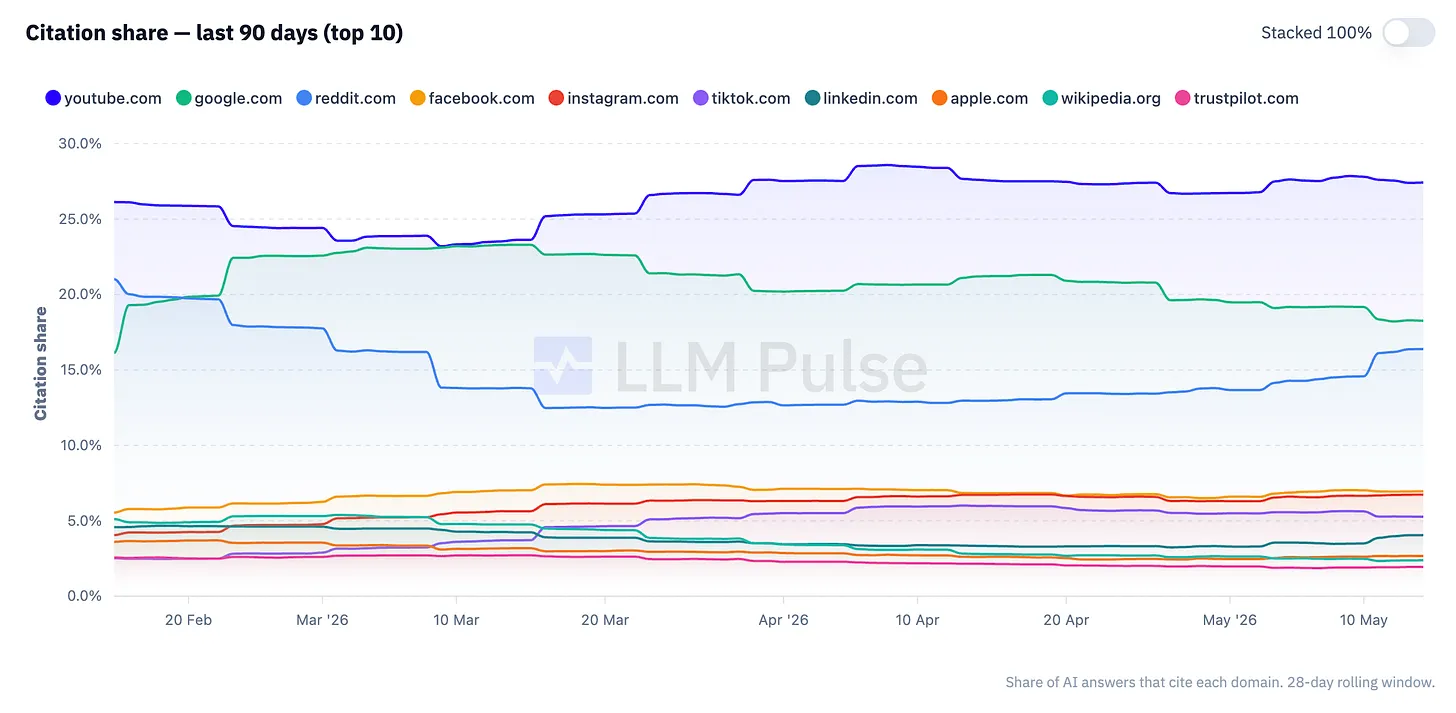
Read that again. 96%.
That means only 4% of what makes you appear (or not) in ChatGPT, Perplexity, or Gemini comes from your own website. The other 96% comes from press articles, reviews, comparisons, forums, Reddit, YouTube, Trustpilot, niche publications... sites you don't control.
This is the exact opposite of what on-page SEO has taught you. In classic SEO, you optimize your site to rank your site. In GEO, what others say about you is what determines whether AI recommends you or not.
I say this every day and I'll say it again here: GEO is much more about what others say about you than about what you say about yourself.
And this is exactly why GEO is fundamentally off-page: because the on-page and technical sides of GEO are practically identical to SEO (you still need a well-built site), but it's in off-page where AI visibility is actually won or lost. Unlike classic SEO in enterprise, where 100 more backlinks didn't move the needle on a site with 100,000, in GEO what people say about you on third-party sites does make a brutal difference in answers, mentions, and recommendations.
The important nuance: it depends on who you are
That 96% is an average. And like every average, it comes with caveats worth explaining.
If you're a big brand (a Volkswagen, a Slack, a Booking), a huge share of what AI knows about you comes from external sources. There are thousands of articles, reviews, comparisons, Reddit threads, YouTube videos talking about you. Your own content is a drop in an ocean of third-party mentions. For these brands, off-page is everything.
But in more niche industries, or for smaller brands, the share of your own content goes up. Simply because there isn't that much third-party content on the topic. If the queries are very specific and nobody has written much about that space, your own site carries more weight.
There's a nice parallel here: the more people talk about you, the less control you have. The bigger you are, the more your AI visibility depends on what others say. And that's exactly what makes off-page GEO so relevant for enterprise and big brands.
Why it's hard to embrace GEO
If GEO is fundamentally off-page, and most of us have spent our entire careers focused on on-page... then yeah, it's hard. This isn't a criticism, it's an observation. I struggled with it myself at first.
GEO forces you to collaborate with PR teams, with digital reputation agencies, with social strategy. It forces you to depend on what others do. And for a profile that has built a career on "I control my own variables," that requires a real mindset shift.
Three lines of action in off-page GEO
If GEO is off-page, what do you actually do? I see three clear lines of action, and I'll call out some companies I see doing this really well:
Press and media mentions. Press articles, mentions in industry media, interviews, collaborations with journalists... everything that feeds the sources LLMs use to build their answers. Companies like Tinkle have been doing this for years and now it turns out their work is exactly what AI needs to recommend brands. PR was always off-page by nature. Now it's also GEO.
Social and community. Reddit, YouTube, niche forums, Instagram, TikTok, Facebook... these are massive citation sources in AI. YouTube leads as a citation source in Google AI Mode. Reddit already appears as a citation in 15% of answers in our data. And yet almost nobody is working their presence on these platforms with a 100% AI-visibility focus. There are people doing it, yes, and we see them inside LLM Pulse, but it's still a very green field and I don't see anyone tackling it at depth yet.
Negative mention management. This is something a lot of people don't have on their radar: AI also reads the negative stuff. If there's negative content about your brand on relevant sources, that shapes how (or whether) a model recommends you. Agencies like 202 Digital Reputation, who have been working in online reputation management for years, are expanding their focus into AI. With LLM Pulse they work precisely to identify those negative sources and act on them.
And beyond those three, there's a whole mix of sources that can be relevant for any project — for mobile apps it's their presence in the app stores (our friends at PickASO do this brilliantly), and broadly speaking there are many agencies with SEO/GEO teams doing very, very good work in this area from what I've seen so far: Flat101, t2ó, Elabs Consulting, Prodigioso Volcán, among others.
The elephant in the room: Google's guidelines
Just as I'm writing this, Google has published its "AI optimization guide" (May 15, 2026), and half the industry has jumped on it. The guide basically says that GEO and AEO are "still SEO," that you don't need to do anything special, that there's no need for llms.txt files, special schema, or chunking. That what works for SEO works for AI Search.
And yes, llms.txt probably does nothing for most sites, and you don't need to chunk anything or go wild with schema.
I think it's fine that Google publishes this. But I have a couple of reflections:
Google has zero incentive to give you good GEO best practices. If they did, we'd start spamming the models in exactly the same way we've been spamming search for the last 20 years. It took Google a very long time to start sharing SEO guidelines. They went more than a decade without publishing any. They've taken 20-25 years to get to the level of documentation they have today. And now we expect them to hand us the complete AI Search playbook? That's expecting too much. The guidelines Google publishes today for SEO are still very basic and very vague.
The team publishing these guidelines isn't the team building the models. Gemini is built by Google DeepMind. The Google Search team, which is the one giving us guidelines, gets the model after it's already built and integrates it into AI Overviews or AI Mode. They're different teams with different objectives. It's like having a car company's marketing team explain how the engine works.
And there's one more thing: Google has never given very specific recommendations on anything. But it turns out a lot of people are now thrilled that these guidelines say "you don't need to do anything different," because it confirms what they already wanted to believe. Curiously, this same crowd, when Google says something they don't like, pulls out the classic "Google is lying to us." Everyone gets to pick their narrative.
What's clear to me is that AI Search is much bigger than Google. It's ChatGPT, it's Perplexity, it's standalone Gemini, it's Claude, it's Copilot. If your strategy is based purely on what Google tells you about AI Overviews, you're looking at a slice of the pie and thinking it's the whole pie. In the end, everyone has to decide where they stand on this. I can only share what I see in the data and what I think is going to happen.
What doesn't change (and what does)
I'm not saying on-page SEO is dying. Your website is still your foundation, your calling card, the place where you convert. A technically healthy site, well structured, with good content, is still the starting point and absolutely essential.
What I am saying is that it's no longer enough. If you only do on-page, you're ignoring the vast majority of what influences your AI visibility. And as AI eats a bigger slice of the user journey, that gap is going to hurt more and more.
I believe SEOs still have the opportunity to lead the way in AI search — with GEO as the discipline that owns the optimization of that channel. But from where I sit at LLM Pulse, with all this reluctance, other players are stepping into the gap: PR agencies, reputation firms, growth teams, brand teams, and more — all taking ownership of the channel if SEO won't.
SEO as we know it is going to become part of something bigger. Some will call it SEO, some will call it GEO, some will invent yet another name. It doesn't matter. What matters is that what needs to be done is different, and whoever doesn't do it isn't going to show up like before.
That's it for today. I'd love to hear what you think. Do you believe GEO matters? Do you agree off-page is the key in this new era? Reply to this email or hit me up on LinkedIn/X.
Thanks for reading Seopatía. Until next time! :)
%20(1)%20(1).png)