
AI has not killed the media. It is reordering them.
That is the feeling I get after looking at aggregated LLM Pulse data from AI answers in Spain. I wanted to answer a simple question: when ChatGPT, Perplexity, Gemini or Google answer with sources, which Spanish media outlets actually show up?
The short answer: PRISA wins.
The more interesting answer: PRISA does not win equally across models. In ChatGPT, it is on another level.

What I measured
For this analysis I used production LLM Pulse answers, aggregated and without exposing prompts, customers or individual answers. If you want similar public studies, we have a Data Studies page with rankings of sources cited by AI.
The sample:
- 743,259 AI answers with at least one source.
- Prompts configured for Spain and Spanish.
- Period: April 10 to July 8, 2026.
- Models: ChatGPT, Perplexity, Google AI Mode, Google AI Overviews and Gemini.
- Copilot is excluded from model comparisons because the sample volume is too low in this period.
- 82 media domains grouped manually by publishing group.
The main metric is simple: the percentage of sourced answers in which at least one domain from the group appears.
Important: I count answers, not URLs. If the same answer cites two PRISA domains, it still counts as one answer with PRISA. That avoids inflating the number with duplicates inside the same answer.
One more caveat: this is not a universal audit of every media outlet in Spain. It is a measurement over a curated list of relevant domains inside the LLM Pulse sample. If a domain is missing, the ranking could move a bit. Even so, the distance between the first groups is large enough that the pattern is hard to ignore.
One in four sourced results cites a media outlet
Out of the 743,259 sourced answers, 183,443 cite at least one of the media domains I grouped.
In other words: 24.68% of answers include a media outlet.
That is news in itself. A lot of conversations about AI talk about "the death of traffic" or "models taking everything". But when you look at answers with sources, media outlets are still a huge part of the system. They do not always get the click. They do not always get visible brand exposure. But they feed the answer.
And that is where the new fight starts: ranking in Google matters, but so does becoming a source for the layer that answers.
The ranking by groups
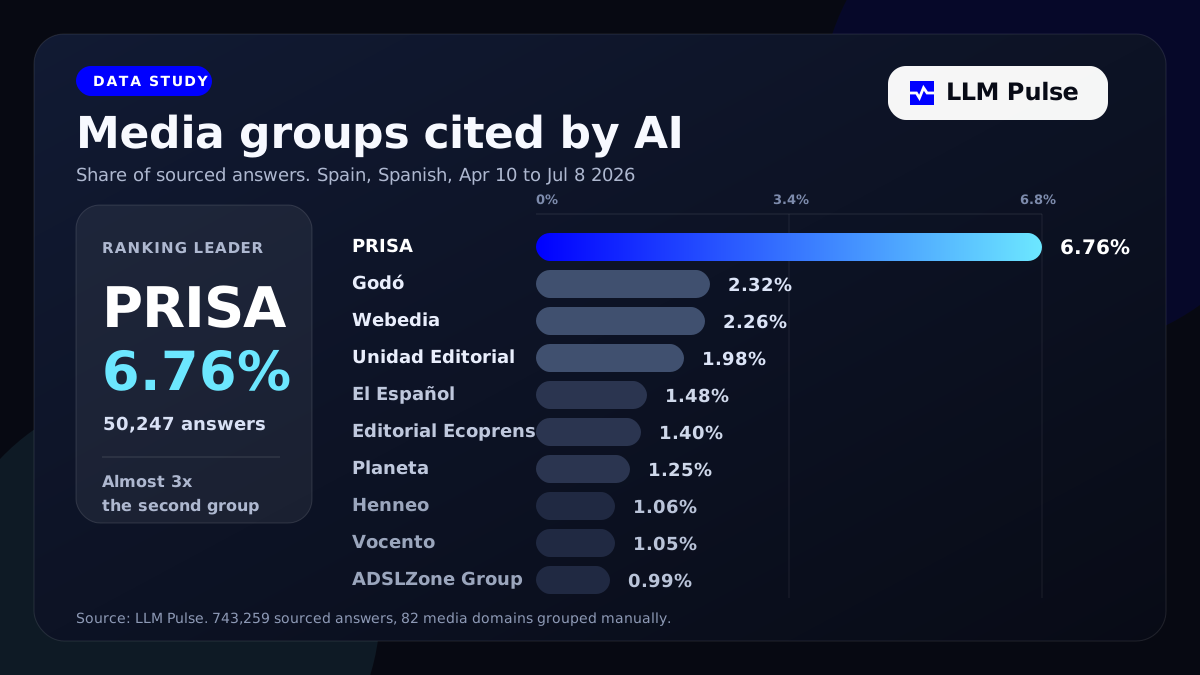
These are the groups with the most visibility in the sample:
| Group | Sourced answers | Share | Main domains |
|---|---|---|---|
| PRISA | 50,247 | 6.76% | El País, AS, Cadena SER, HuffPost |
| Godó | 17,225 | 2.32% | La Vanguardia, Mundo Deportivo |
| Webedia | 16,819 | 2.26% | Xataka, Xataka Móvil, Motorpasión, Trendencias |
| Unidad Editorial | 14,743 | 1.98% | El Mundo, Expansión, Marca, Telva |
| El Español | 11,033 | 1.48% | El Español |
| Editorial Ecoprensa | 10,428 | 1.40% | elEconomista |
| Planeta | 9,303 | 1.25% | La Razón |
| Henneo | 7,859 | 1.06% | 20minutos, Heraldo |
| Vocento | 7,819 | 1.05% | ABC, El Correo, Las Provincias |
| ADSLZone Group | 7,355 | 0.99% | ADSLZone and tech verticals |
| El Confidencial | 7,239 | 0.97% | El Confidencial |
| Axel Springer | 7,086 | 0.95% | Auto Bild |
PRISA appears in 50,247 answers. That is 6.76% of all sourced answers.
The second group, Godó, appears in 17,225 answers, a 2.32% share.
Translated: PRISA appears almost 3 times more than the second group.
The difference does not come from a tiny domain sneaking in through a weird vertical. It comes mostly from El País.
El País appears in 35,222 answers, 4.74% of all sourced answers. In the global domain ranking for the whole sample, not just media, it ranks sixth. Ahead of it are YouTube, Reddit, Google, Instagram and TikTok. Then comes El País.
That is a very strong data point. Inside AI, El País is competing with other newspapers and with the big platforms that models use as raw material.
The twist is in ChatGPT
If the article stopped at "PRISA leads the ranking", it would be interesting but fairly predictable. El País has authority, history, a lot of URLs and a lot of fresh content. It makes sense that it performs well in AI.
The strange part appears when you split by model.
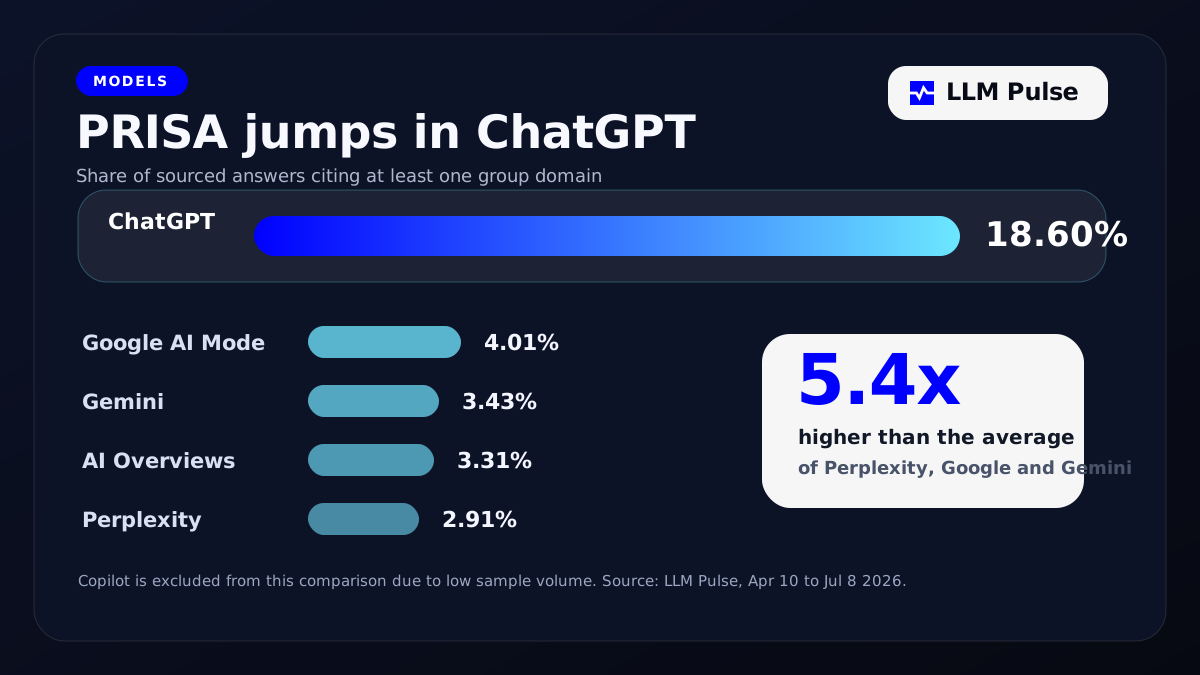
PRISA appears in:
- 18.60% of ChatGPT sourced answers.
- 4.01% of Google AI Mode sourced answers.
- 3.43% of Gemini sourced answers.
- 3.31% of Google AI Overviews sourced answers.
- 2.91% of Perplexity sourced answers.
ChatGPT cites PRISA domains 5.4 times more than the average of the other four models.
That is the stat of the post.
It is not a small methodological difference. It is not ChatGPT being one point above the rest. It is a different order of magnitude.
And when you go down to specific domains, the pattern is even clearer:
| Domain | ChatGPT | Perplexity | AI Mode | AI Overviews | Gemini |
|---|---|---|---|---|---|
| elpais.com | 12.37% | 2.05% | 3.06% | 2.66% | 2.45% |
| as.com | 2.95% | 0.62% | 0.91% | 0.58% | 0.85% |
| cadenaser.com | 4.22% | 0.11% | 0.03% | 0.006% | 0.11% |
Cadena SER may be the strangest symptom. In ChatGPT it appears in 4.22% of sourced answers. Outside ChatGPT, it almost disappears.
I am not saying there is only one explanation. It could be crawling differences, source preferences, freshness, format, topical coverage, content availability, commercial deals or some mix of all of that. But the pattern is there.
The uncomfortable part: content deals
This is where we need to be careful.
OpenAI announced a deal with PRISA Media and Le Monde on March 13, 2024. In that announcement, OpenAI said content from titles such as El País, Cinco Días, AS and El HuffPost would be available in ChatGPT with attribution and links, and would also contribute to model training.
For broader context, LLM Pulse keeps an updated map of OpenAI publisher deals, with more than 20 verified partnerships and 160+ outlets covered between 2023 and 2026. PRISA appears there as one of OpenAI's first non-English publisher bets.
Then PRISA announced a deal with Perplexity on December 9, 2024. PRISA presented it as a distribution and monetization path for its titles inside AI search. That deal sits in the context of Perplexity's publisher program, designed to share ad revenue with media partners.
Does that mean the OpenAI deal explains the ChatGPT number?
I cannot say that.
It would be tempting to write "OpenAI favors PRISA because of the deal" and close the post with a punchy line. But it would not be honest. Observational data does not prove causality.
What I can say is this: ChatGPT's behavior with PRISA does not look like Perplexity, Gemini or Google. And PRISA is one of the Spanish groups that has signed relevant deals with AI companies.
That combination deserves a conversation.
The side effect: branded content gets pricier
There is a commercial derivative that I think matters. If a group appears more often in AI answers, its branded content can become more attractive.
Until now, many brands have paid for links. Link building, coverage, SEO authority, media mentions, that whole world. But if part of search moves into AI-generated answers, the question changes a bit. The request moves away from "I want a link from this publication" and closer to "I want to be in a source that AI can use when it answers about my category".
That is where content deals can have a strange effect. Beyond direct licensing or distribution revenue, they can indirectly increase the commercial value of editorial inventory and branded content. If a publication has more presence in ChatGPT, a well-made sponsored article inside that publication may look more valuable to a brand that wants to appear in the answer layer.
I am not saying this is guaranteed. Weak branded content is still weak branded content. And a publication having AI visibility does not mean any sponsored piece will appear. But it does change the commercial conversation. The media outlet sells audience, authority, links and, increasingly, a higher chance of entering the visible corpus models use.
That is a new business. Or at least a new way to sell a business that already existed.
Robots.txt: who lets OpenAI in
I also checked the robots.txt files of the main titles in the ranking. I did this on July 9, 2026, so this is a point-in-time snapshot: these files change.
It is worth separating two bots. According to OpenAI's crawler documentation, GPTBot is used for content that may help train models, while OAI-SearchBot is used so a website can appear in search results inside ChatGPT. So for ChatGPT Search visibility, the more relevant bot in this table is OAI-SearchBot.
I read "yes" as a general block with Disallow: / for that bot. "No" means I did not see a general block, though specific paths can still be blocked.
| Publication | Blocks GPTBot | Blocks OAI-SearchBot |
|---|---|---|
| El País | No | No |
| AS | No | No |
| Cadena SER | No | No |
| HuffPost | No | No |
| La Vanguardia | Yes | No |
| Mundo Deportivo | No | No |
| Xataka | No | No |
| Xataka Móvil | No | No |
| Motorpasión | No | No |
| Trendencias | No | No |
| El Mundo | Yes | Yes |
| Expansión | Yes | Yes |
| Marca | Yes | Yes |
| Telva | Yes | Yes |
| El Español | No | No |
| elEconomista | Not checked | Not checked |
| La Razón | Yes | No |
| 20minutos | Yes | No |
| Heraldo | Yes | No |
| ABC | Yes | Yes |
| El Correo | Yes | Yes |
| Las Provincias | Yes | Yes |
| ADSLZone | No | No |
| El Confidencial | Yes | Yes |
| Auto Bild | No | No |
The quick read: the main PRISA titles pushing the number do not generally block either GPTBot or OAI-SearchBot. Unidad Editorial, Vocento and El Confidencial look much more closed to OpenAI. Godó sits somewhere in the middle: La Vanguardia blocks GPTBot, but not OAI-SearchBot.
This does not prove causality either. An open robots.txt does not guarantee you will appear in ChatGPT, and a block does not explain the whole ranking on its own. But it adds one more piece: deals, technical openness and source selection are not the same thing, even if in practice they can end up mixing.
Other patterns I found interesting
Beyond PRISA, the ranking leaves a few useful readings.
Webedia is very strong, but in a different way. It does not depend on one generalist title. Xataka, Xataka Móvil, Motorpasión and Trendencias build a distributed presence in verticals that models use a lot: technology, mobile, cars, consumer topics, lifestyle. It is less institutional and more practical.
Unidad Editorial has almost the opposite pattern to PRISA. In the aggregate it ranks fourth, with El Mundo, Expansión and Marca doing a lot of the work. But in ChatGPT its share falls to 0.75%, while the average across the other models is around 1.88%. It is a good reminder that "media authority" does not mean the same thing in every AI engine.
Europa Press does not make the main table, but it has another strange data point: it appears much more in ChatGPT than in the rest. In ChatGPT it reaches 3.19%; in the average of the other models it sits around 0.33%. It could be agency format, coverage, how its content gets reused or how systems crawl it. I do not know yet, but I would put it on the list of things to investigate.
Godó does well thanks to La Vanguardia and Mundo Deportivo. It does not have PRISA's ChatGPT spike, but it keeps a stable presence.
Henneo, ADSLZone Group and some car verticals show something else: AI cites big newspapers, but it also uses a lot of specialized sites when the question asks for a practical answer. This matches what we see in other sectors: for GEO, general authority helps, but specialization also matters.
What this means for media, brands and PR
The most important reading for media is pretty direct: information distribution is no longer decided only in Google Search, Discover, social media or the homepage.
It is also decided inside an answer.
And inside that answer there are several layers:
- Whether the model uses your content.
- Whether it shows your domain as a source.
- Whether the user sees your brand.
- Whether the link exists and gets clicks.
- Whether the model turns you into a reference even when there is no visit.
For media companies, this changes the negotiation. A deal with an AI company can be a license for historical content and, at the same time, a way to secure future presence in the place where the answer is built.
For brands and PR teams, the reading matters just as much. It is no longer enough to ask "which media outlets send me traffic". You also have to ask "which media outlets does AI use as evidence when it answers about my sector".
If a publication appears often in AI answers, a mention there may matter more than its referred traffic suggests.
This is exactly what we are seeing in GEO: the source is no longer valuable only because of the click. It is valuable because it can enter the answer.
My conclusion
PRISA is currently the Spanish media group with the highest visibility in this sample of AI answers. It wins by a lot in the aggregate, and it wins especially hard in ChatGPT.
I cannot prove that content deals explain the pattern. But I can say the pattern exists and it is not distributed equally across models.
That is the important part for me.
The new SEO for media goes beyond publishing more, indexing better or getting links. It is about understanding which sources each model considers citable, which deals change distribution and which titles end up becoming part of the answer.
Google ordered links.
AI orders sources.
And in Spain, at least in these three months of data, PRISA starts the race with a big advantage.
Data: LLM Pulse, sourced answers in Spain and Spanish prompts between April 10 and July 8, 2026. Public sources used for context: OpenAI on PRISA and Le Monde, LLM Pulse's OpenAI publisher deals map, PRISA on Perplexity, The Verge on Perplexity's publisher program and OpenAI on its crawlers. The robots.txt files linked in the table were checked on July 9, 2026.
%20(1)%20(1).png)